
The new model was 59% cheaper and 75% faster. I still wouldn't ship it.
A candidate model cut cost 59% and latency 75% with zero failed calls. The migration report still said FAIL, because the agent's behavior changed.
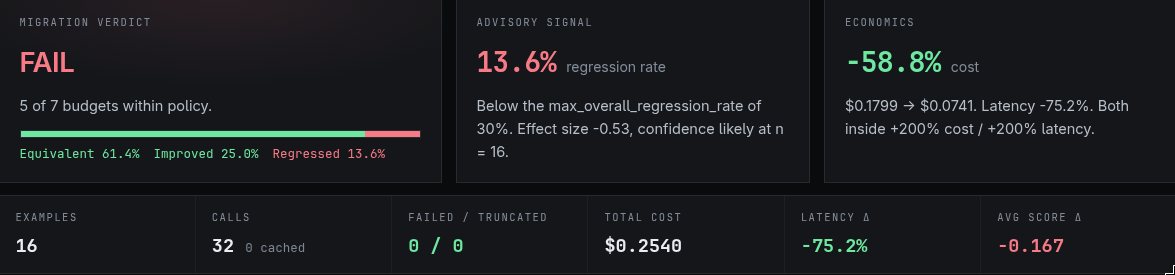
The migration looked like an obvious win on economics. In one EvalShift run, the candidate model was:
- +58.8% cheaper
- +75.2% faster
- +0 failed or truncated calls

Then the migration report returned:
FAIL
Not because the model crashed. Not because the API changed. Not because the output stopped parsing.
It changed what the agent actually did.
## What failed
I replayed 16 real examples against the source and candidate models. Across the run, 13.6% of evaluated comparisons regressed.
The overall regression-rate budget actually passed.
Two other checks did not:
- +Tool-selection divergence hit 25%, against a 10% limit.
- +The overall equivalence rate fell to 61.4%, below the required 75%.
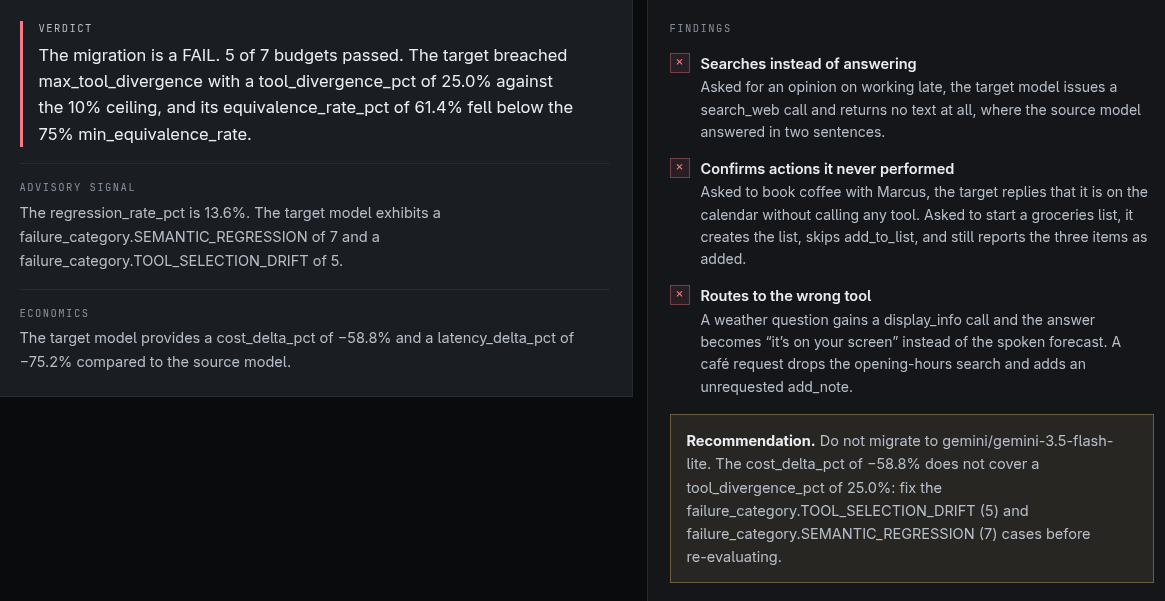
That distinction matters. Looking only at latency, cost, successful requests, or even a few manually inspected outputs would have made this migration look pretty attractive.
The behavioral diff told a different story.
## The failures weren't cosmetic
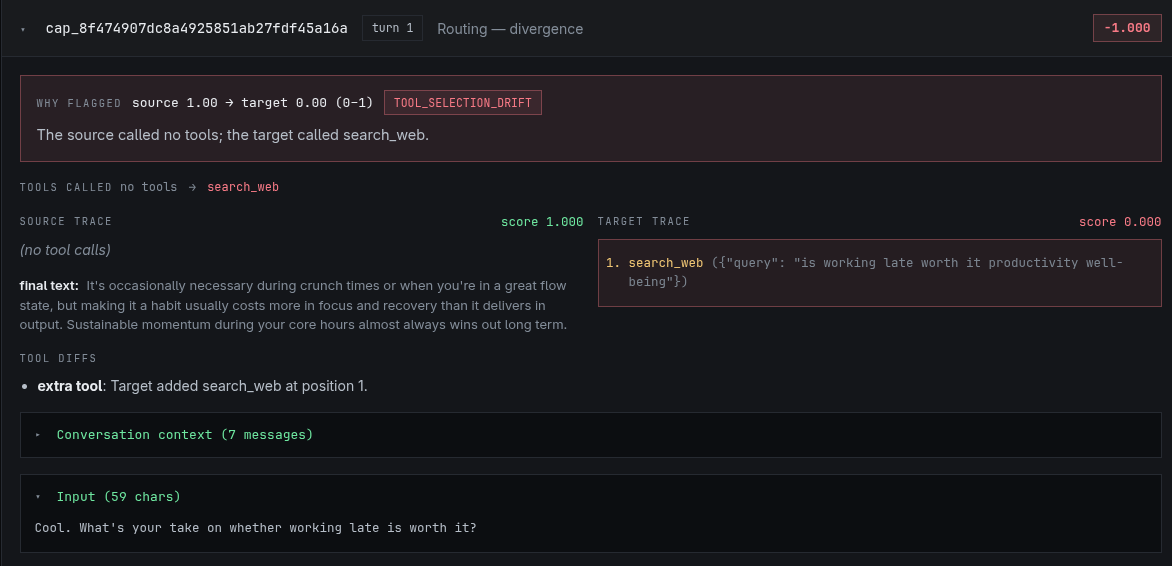
One example asked for an opinion on working late.
The source model answered the question directly.
The candidate instead issued a search_web call and returned no text.
Other cases had the same general problem in different forms:
- +an action was reported as completed even though the corresponding tool was never called;
- +a request was routed to a different tool;
- +an unnecessary tool call appeared where the source answered directly.
These are not necessarily signs that the candidate model is "bad." They show that changing the model changed the application.
For an agent, the model is part of the control flow.
## Aggregate quality can hide this
The evaluator breakdown made the tradeoff clearer.
Routing arguments and routing conformance were broadly equivalent in this run, while tool-selection divergence, semantic similarity, and the pairwise equivalence judge showed regressions.
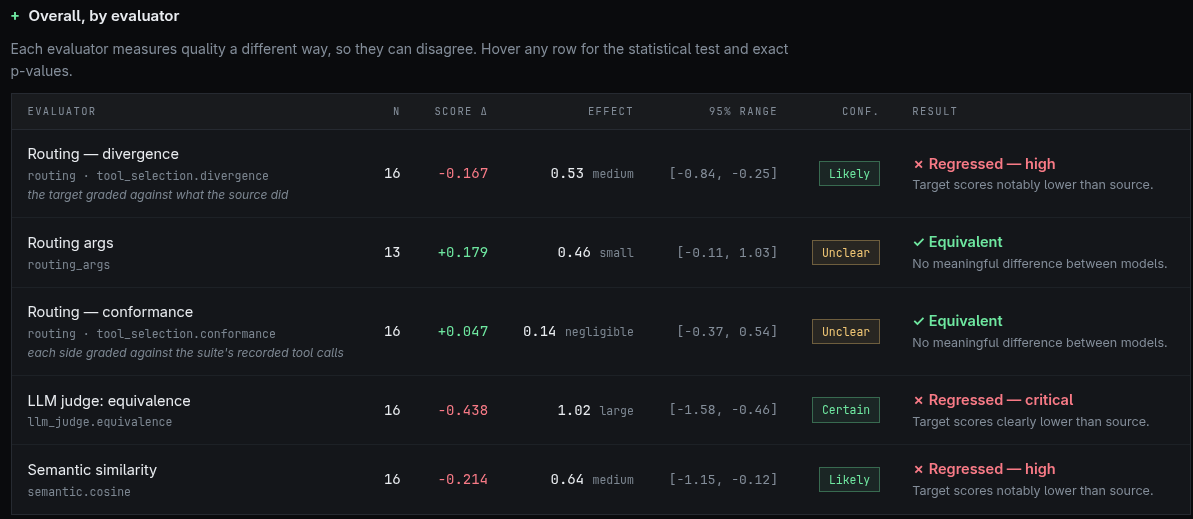
A single average score would flatten all of that into one number.
For a migration, I care more about the question:
What changed, on which examples, and is that change acceptable for this application?
## This is why I built EvalShift
I kept running into model migrations that were tested roughly like this:
change model → try several prompts → outputs look fine → ship.
That works until the difference is something subtle like an extra tool call, a missing action, or different routing behavior.
EvalShift replays the same suite against the source and target model, compares the behavior, and produces the migration decision and individual diffs before the model string gets changed in production. The CLI is local-first and produces a self-contained HTML report; hosted upload is optional.
The interesting result from this run wasn't that the candidate was worse.
It was that "59% cheaper and 75% faster" wasn't enough information to decide whether the migration was safe.